

Narrow your search
Modification Details
Translate Evilution
german french spanish italian greek finish danish polish japanese russian
Search Evilution
Most Viewed Pages
Most Rated Pages
Alternator Testing
Find out if the alternator is charging the battery

Checking The Alternator

All you need for this test is a multimeter or a volt meter. You do own one right?
If not, shame on you, they are very handy things to have.


With the probes fitted, turn the meter on and select volts. If yours auto senses the range
then that's fine. If you have to chose a range you want it to show between 10 and 15 volts.

Locate the battery in your car. If you don't know where it is, look
here.

Leave the car turned off for now. Put the red probe on the + battery terminal and the
black probe on the - battery terminal. At rest, with no electrics being used in the car,
the voltage should be above 12 volts but below 13 volts.

This shows my battery voltage just after a full charge.


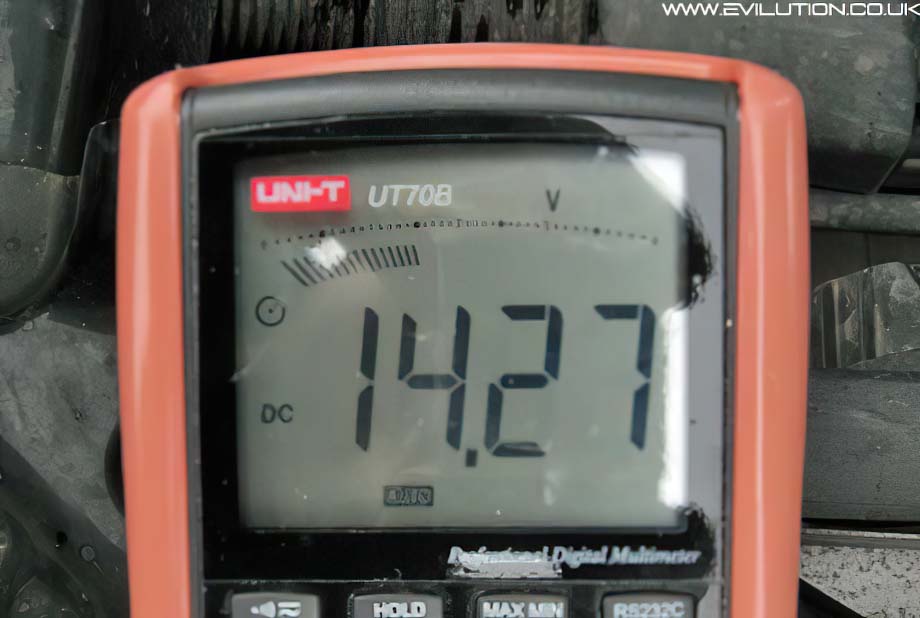
Start the car from cold and place the probes back on the battery terminals. Expect to see
something between 14.2 and 14.5 volts but anything between 14 and 15 volts is fine.
This is the voltage taken from OTV's Roadster when running.


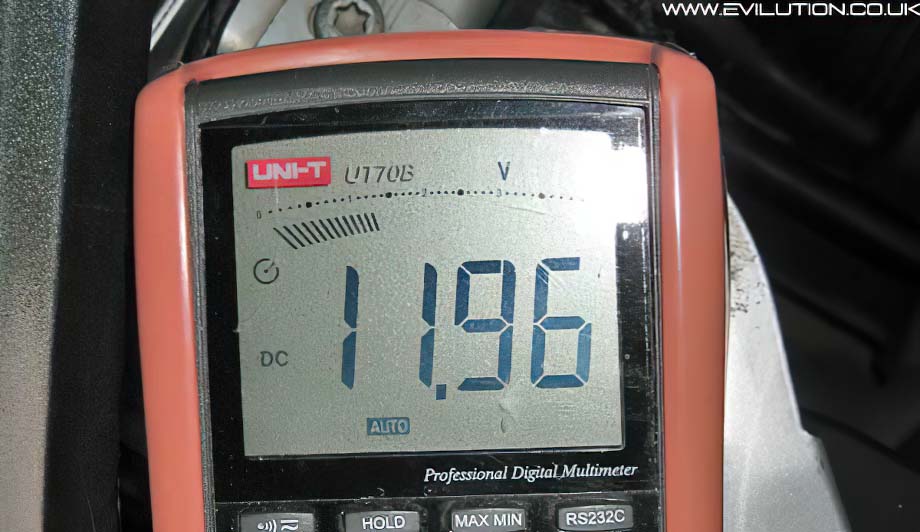
If, however, the car shows less than 14 volts then the alternator is having problems creating the charge voltage, the battery won't be properly charged and the alternator will deteriorate.
If the voltage is less than the battery's resting voltage then the alternator is not working at all.

This is the voltage on my Roadster with the engine running. Clearly a problem with the alternator.


Troubleshooting A Faulty Alternator

There are a few things that can cause no or low voltage output.

Diode Lead

This isn't found on all smarts but they do fry and stop any charging. It is a short lead running from the PHIN terminal to an earth point on the car. The lead contains a diode to control the direction of current. If the diode burns out or breaks down, the alternator will not charge.

Damaged Exciter Cable

The alternator creates electricity by rotating magnets inside a coil.
Some alternators require a little power to jump start the process.
This power comes in through the exciter cable and is fed from the fuse box or ECU.

Seized Alternator

Usually the engine won't even turn but it has been known with a loose belt. Click here.

Loose Power Cable

Haven't seen one yet but it's always a possibility. Check battery and alternator end.

Blown Rectifier

The rectifier converts AC to DC to charge the DC battery.
It is large component inside the alternator and is the main reason alternators fail.

Why Test The Alternator When The Car Is Cold?

The alternator is always outputting a voltage but this will vary depending on the load placed on it.

Starting from cold gives you a better base line for testing because (and let's be honest) you aren't
going to be able to change the alternator that quickly so the car will be cold. Plus, if the alternator
was faulty you wouldn't be able to drive the car enough to bring it up to operating temperature.

When you start the car from cold you get the engine pre-heater kick in which is a massive drain.
This causes the alternator to output more power to cope with the intense drain.

AC Ripple

An alternator creates alternating current (AC) but the battery systems of the car use
direct current (DC). The rectifier converts the AC to DC however it is fairly common for
the rectifier to break down slowly instead of failing outright. When this happens you
get a small amount of DC leaking into the AC which affects the DC wave form.

AC alternates between + and - voltages whereas DC is a constant + voltage.

If AC starts to leak through it will create small dips in the DC waveform which is effectively reducing
the voltage at each dip. Best case scenario you will start to notice the lights phasing or flickering,
worse case is that sensors start to misread, electronics fail and the car won't function.

Using a multimeter you should test the voltage at the battery with the car running.
Ideally you should see an AC voltage of less than 0.1v.

However, many cheap multimeters have issues checking AC through DC so you may get some silly
readings like 30 volts AC which is clearly incorrect. In this case you should use an oscilloscope.

Of course it's a lot easier to take it to a local garage and get them to check it.


Click if Info Helpful

Buy me a drink

Contact us about mod

Print page

Translate

Back to top